

Quick Overview
A good real estate agent listens to your goals, knows the relevant local market, explains recommendations with evidence, communicates reliably, and protects your interests throughout a purchase or sale. The strongest signs appear in what the agent does, not just in reviews or sales claims.
- They ask about your priorities before suggesting homes or a listing price.
- They explain local comparable sales, market conditions, and realistic trade-offs.
- They respond as agreed and keep you informed when something changes.
- They discuss risks, representation, services, and fees without pressure.
- They show relevant transaction experience and know when a specialist is needed.
If you’re wondering what makes a good real estate agent, don’t judge solely by a five-star profile or an impressive sales number. A useful test is whether the person helps you make better-informed decisions, including when the advice is not what you hoped to hear.
At Find My Agent Michigan, we believe a strong match starts with both professional ability and fit for your situation. The following nine signs help buyers and sellers recognize quality before hiring an agent and assess whether someone already representing them is delivering the service they need. For the wider search and hiring process, see our Michigan guide to finding a great real estate agent.
1. They Listen to Your Goals Before Offering Solutions
A thoughtful agent asks what you’re trying to accomplish, not simply how quickly you want to close. Buyers should expect questions about budget, essential features, financing, location, and acceptable compromises. Sellers should be asked about property condition, desired timing, financial priorities, and how much preparation they can manage.
One of the clearest signs of a good real estate agent is the ability to summarize your priorities accurately and adjust recommendations when they change. If avoiding a rushed move matters more than securing the highest price, the agent should account for that. Listening is not the same as agreeing with every request; good advice may challenge an unrealistic expectation.
2. They Know Your Michigan Market, Not Just the State
“Michigan experience” is too broad on its own. An agent familiar with condominium transactions in Ann Arbor may have a different skill set from someone who handles rural acreage near Traverse City or suburban homes in Oakland County. Ask about recent work in your community and property category.
A knowledgeable agent can discuss comparable sales, competing listings, inventory, and factors that could affect demand without pretending to predict the market perfectly. Buyers should hear how an asking price compares with similar homes. Sellers need defensible pricing, not a number chosen to win the listing.
Local insight is one of the essential qualities of a good real estate agent, but it needs to be demonstrated through specific examples – not just neighborhood names on a profile.
3. Their Recommendations Come With Evidence
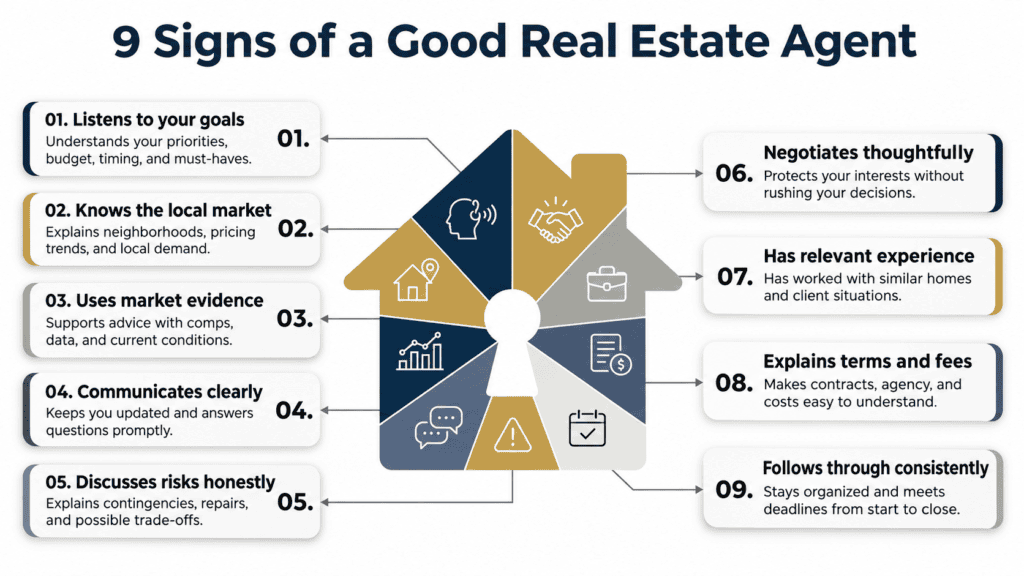
Ask your agent: “What makes you recommend that?” For a seller, that might mean reviewing a comparative market analysis, property condition, and recent sale prices. For a buyer, it might mean explaining offer terms, financing considerations, inspection findings, and how a home’s price compares with alternatives.
Example: A seller in Troy wants to list well above recent comparable sales. A useful agent explains the pricing evidence, possible consequences of overpricing, and a plan to monitor early listing activity. They do not guarantee a particular sale price or dismiss the seller’s goals.
This evidence-first approach is part of what makes a good real estate agent: you can understand the reasoning even when you ultimately choose a different option.
4. They Communicate Reliably and Close the Loop
Good communication is not about being available every minute. It means agreeing on a reasonable response window, using your preferred contact method where practical, and explaining what happens next. When an inspection raises a question or a deadline slips, you should know what requires your attention.
Notice whether the agent answers questions, follows up, and explains when they are waiting for others. An organized team can work well, too, provided you know who is responsible for each task.
A missed call is not automatically poor service. Repeated unanswered questions, unexplained gaps, and surprises about important deadlines are more meaningful warning signs.
5. They Tell You About Risks Without Pushing a Decision
An agent should advocate for your interests, not treat every hesitation as an objection to overcome. For buyers, that includes an honest discussion of inspection contingencies, appraisal issues, financing uncertainty, and the potential consequences of waiving protections. For sellers, it means explaining offer strength beyond price, including financing, contingencies, concessions, and timing.
The question of what makes a good real estate agent becomes especially important when the situation is stressful. The right professional lays out options and consequences, gives you room to consider them, and respects that the decision is yours.
Pressure to buy beyond your budget, accept an offer without understanding its terms, or sign immediately without reviewing a document is a reason to pause and ask questions.
6. They Negotiate Thoughtfully and Manage Problems
Negotiation is not simply demanding a lower price or refusing every concession. Good agents identify which terms matter most, communicate professionally, and help clients weigh the likelihood of an agreement closing successfully. They can explain when a counteroffer, repair credit, adjusted closing date, or different contingency structure may address a problem.
Ask for an anonymized example of a challenging, comparable transaction: What happened, and how did the agent respond? Do not expect confidential client details or a guarantee that your case will end the same way.
The ability to manage uncertainty without hiding it is another part of what makes a good real estate agent. A difficult transaction does not by itself mean the agent performed badly; the response to the difficulty is more revealing.
7. Their Experience Fits the Property and the Client
Transaction count can indicate activity, but volume alone does not establish suitability. A first-time buyer may need someone who explains the sequence from preapproval to closing. A condo buyer may need help identifying association documents and questions for qualified reviewers. A seller of inherited property may need an agent comfortable coordinating with an estate representative and other professionals.
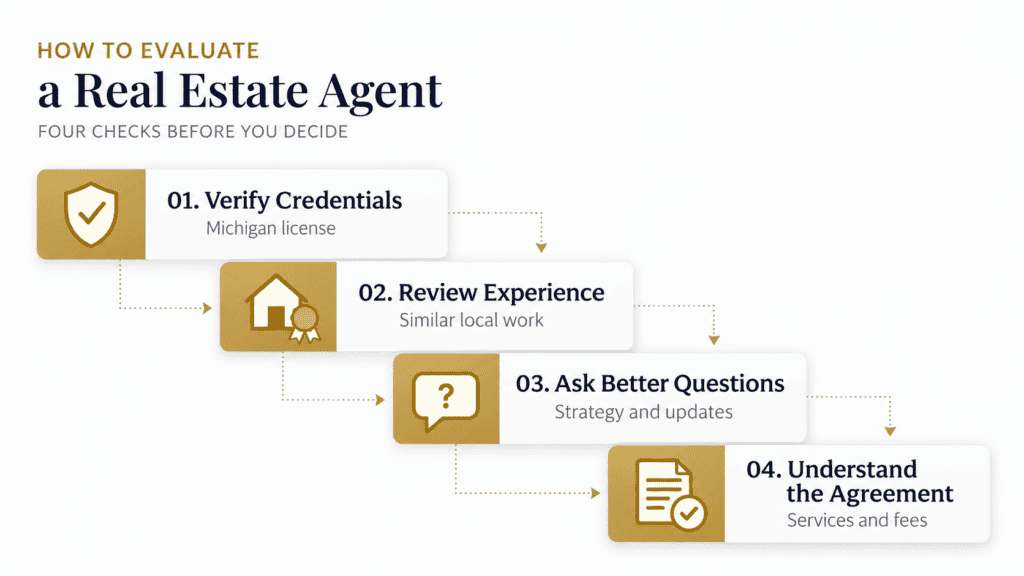
Ask whether the agent has recently handled comparable situations, what they personally do, and what is delegated to assistants or teammates. A strong agent also knows the limits of real estate expertise and refers legal, structural, title, tax, or lending issues to qualified professionals.
At Find My Agent Michigan, relevant experience and specialization are central to how we describe our matching approach, not generic claims that every agent is right for every property.
8. They Are Clear About Representation, Compensation, and Agreements
Professionalism includes explaining who the agent represents and what services you are agreeing to receive. Michigan’s agency disclosure law requires licensees to explain available agency relationships and the duties involved before a potential buyer or seller shares transaction-specific confidential information. The required disclosure is written.
Buyer representation and listing agreements can address services, compensation, duration, exclusivity, and termination. Under nationwide practice rules, many agents working with buyers must have a written buyer agreement before an in-person or live virtual tour. Compensation is negotiable; the National Association of REALTORS® consumer guide explains the main terms consumers can discuss.
A good agent welcomes questions about these documents and does not rush you past unclear obligations.
9. Their Professional Conduct Is Consistent, Not Just Impressive at First
You should see the same care after the introductory conversation that you saw during it. Does the agent arrive prepared? Keep track of agreed tasks? Correct mistakes promptly? Explain when plans need to change? Respect your confidentiality and your time?
Professional standing is independently checkable. Michigan’s Department of Licensing and Regulatory Affairs offers a free online license search to confirm licensing details and review available disciplinary information. Online ratings and client references can add context, but neither substitutes for checking the agent’s work with you.
Consider these behaviors together. What makes a good real estate agent is a pattern of judgment, honesty, follow-through, and relevant capability…not one impressive promise.
10. How to Evaluate a Real Estate Agent and Spot Red Flags
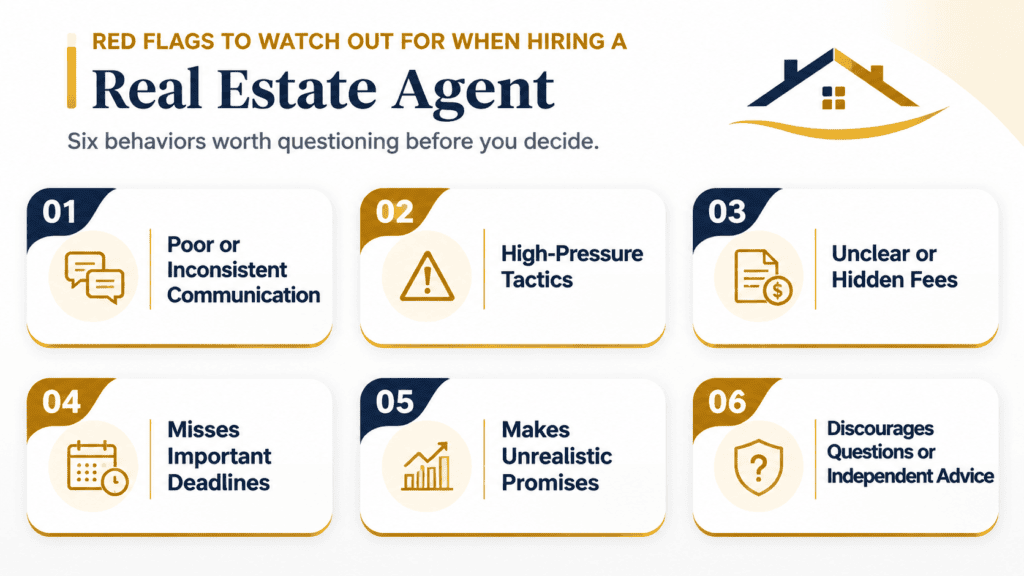
If you’re deciding how to evaluate a real estate agent, focus on observable actions over the first few meaningful conversations or transaction milestones. Ask yourself: Has the agent explained the plan? Can they support their recommendations? Are agreed updates arriving? Do you know what decisions are next? This short review is more useful than judging an agent on a single disappointing showing or offer.
Potential signs of a bad real estate agent include repeated missed deadlines, evasive answers about fees, unsupported pricing claims, persistent pressure, and failure to communicate important developments. Other real estate agent red flags include discouraging reasonable independent inspections or refusing to clarify whom the agent represents. One mistake warrants a conversation; a recurring pattern warrants closer action.
If your real estate agent is not doing their job, document specific concerns, explain the changes you expect, and discuss the issue with the supervising broker when appropriate. Before switching, review any signed agreement for cancellation, exclusivity, and compensation obligations. Seek advice from a Michigan real estate attorney if a contract dispute remains unresolved.
11. How Find My Agent Michigan Looks for a Stronger Fit

We use the same principles behind what makes a good real estate agent when describing what matters in a useful introduction: local knowledge, relevant transaction experience, specialization, responsiveness, and a client-first approach. Our agent-network information says we review professional standing, service areas, background, and approach before considering agents for our network and matching opportunities.
Matching begins with your circumstances. A seller who needs a pricing and marketing plan should not automatically receive the same recommendation as a first-time buyer who needs patient guidance. We consider location, property type, goals, timeline, and relevant expertise. A match is an introduction, not a promise of a particular result or an obligation to hire.
Start with an agent match that reflects your needs. If you’re buying, submit your Michigan homebuyer details. If you’re selling, tell us about your property and selling priorities. Speak with the professional, verify the credentials, and decide whether the relationship is right for you. To understand discovery options before requesting a match, read our guide to finding real estate agent matches in Michigan.
Frequently Asked Questions
How do I know I have a good real estate agent?
Look for clear advice supported by market evidence, dependable follow-up, and a professional who understands your goals. You should be able to ask difficult questions without feeling pressured. An appropriate agent will explain options and acknowledge uncertainty rather than promise a particular outcome.
How to know if your realtor is good after your first meeting?
Notice whether the agent listened, asked about your circumstances, and explained a relevant plan. Check their Michigan license, ask about comparable transactions, and confirm who will handle your work. A friendly first impression matters less than specific answers and follow-through.
Is my real estate agent doing a good job if my house has not sold?
Not selling immediately does not prove poor performance. Ask your listing agent to review showing feedback, comparable properties, pricing, exposure, and the marketing actions actually completed. Judge whether the agent is responding thoughtfully to evidence and keeping you informed, not just whether an offer has arrived.
What should I do if my real estate agent is not doing their job?
Write down missed commitments and request a direct discussion about expectations and next steps. If problems persist, contact the supervising broker and review your contract before attempting to change representatives. For unresolved legal obligations, consult an attorney.
Can Find My Agent Michigan help me assess agent fit before I hire?
Yes. Share your Michigan location, property type, timeline, and buying or selling goals through our buyer or seller form so we can consider a relevant introduction. You can then speak with the agent, ask questions, and decide whether to proceed.